

“A jumbo planter should be allowed to speak.”
A jumbo planter is not just a filler for an empty corner. It’s a statement and an extension of the space. But only if you approach it the right way.For this blog, we spoke with Inge Lohman from Interieurbeplanting de Klerk, who works daily with large planters in offices, hospitality and retail environments. Her approach is clear, practical and sometimes surprisingly simple: “It never starts with the pot. It starts with the location.”
Where does styling a jumbo planter begin?
“Always with the location,” she says firmly. “We first look at the space: how much light is there? Is there direct daylight? How big is the space really? And what happens in that space?”According to her, that’s where the foundation for everything that follows is laid. Only then does the plant come into view.
“You can’t place every plant in every spot. A Strelitzia, for example, is beautiful, but it grows wide. You have to take that into account. We don’t just look at how a plant looks now, but also at how it develops. How does it grow? How much space will it take up later?”
Indoor or outdoor makes less difference in her approach than you might think. “It’s mainly about the environment. Is the planter sheltered or exposed to strong wind? Is it an entrance with lots of movement, or a quiet lobby? That determines what works.”
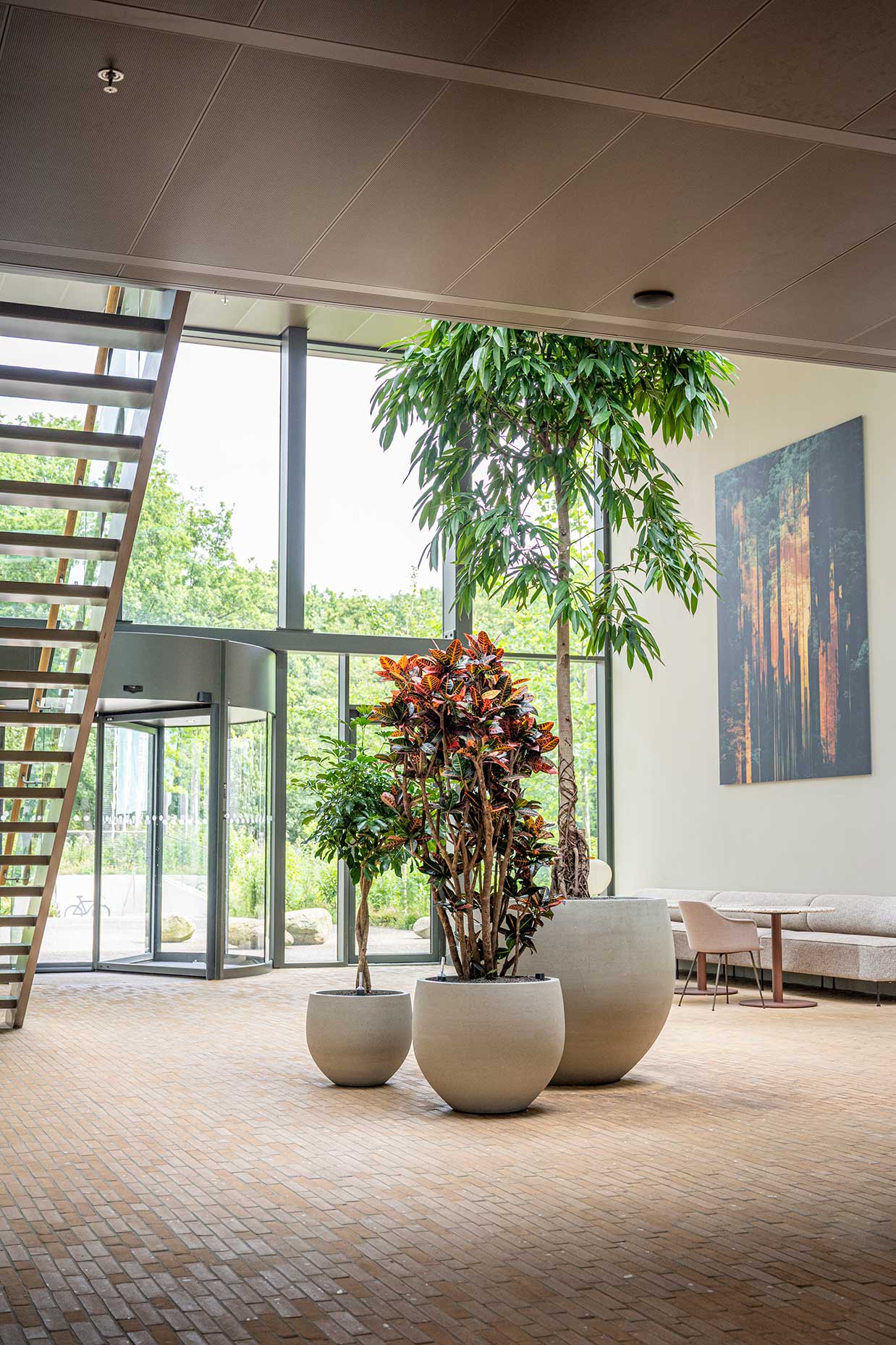
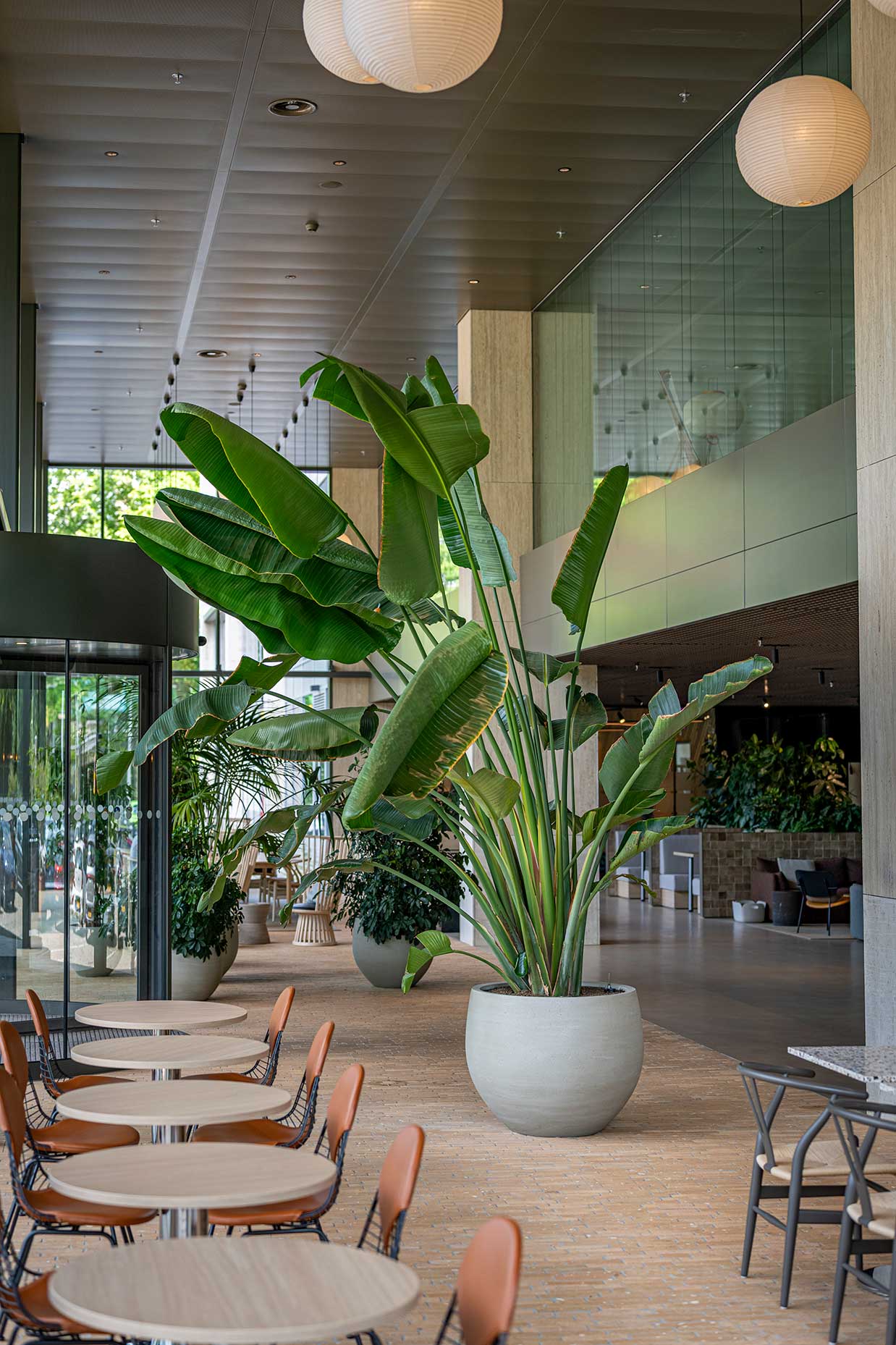
How important is the proportion between planter and plant?
“Crucial,” she says without hesitation. “The most common mistake is a plant that’s too small in a large planter. Visually, it just doesn’t work. A jumbo planter requires volume.”When selecting planting, they consider multiple factors: the width of the plant, the root system, the choice between hydroponics or soil, and sometimes even a combination of multiple plants in one container.
“Sometimes one statement plant gives exactly the calm a space needs. But in other situations, a combination works better because it creates more mass and depth.”
The atmosphere of the space is leading. “In a busy environment, we often choose a calmer silhouette, for example a plant with large leaves. That brings balance. In a minimalist space, you can play with finer foliage or more structure. The question is always: what is the space asking for?”
How do you turn a jumbo planter into a real statement?
“By daring to choose,” she laughs. “A distinctive plant makes the difference. Something just a little different.”But a striking plant alone isn’t enough.
“The golden tip is the combination of planter, plant and surroundings. Those three have to align. You can have a beautiful planter, but if the plant doesn’t fit the scale or atmosphere of the space, it won’t feel right.”
According to her, the finishing details also matter. “We usually work with a crushed stone topping. It looks clean and calm. Bark can quickly feel messy, especially in modern projects. With large planters, you notice those details even more.”
The question is always: what is the space asking for?
What is often underestimated with large planters?
“The practical side,” she says honestly. “Maintenance, for example. We regularly rotate plants toward the daylight so they continue to grow beautifully. With a jumbo planter, that’s physically heavier. You always need multiple people.”So a large planter is not only an aesthetic choice, but also a practical one.
Do you see a development in the use of jumbo planters?
“Yes, absolutely. We see more large gestures instead of small accessories. Designers dare to think bigger and include planters in their interior concept from the very beginning.” And according to her, it doesn’t stop at one solitary object.“What we personally love is working in groups. Not one pot, but multiple sizes together. Different heights or models. Sometimes everything in one color for calmness, sometimes variation within the same family. One space calls for unity, another for contrast.”
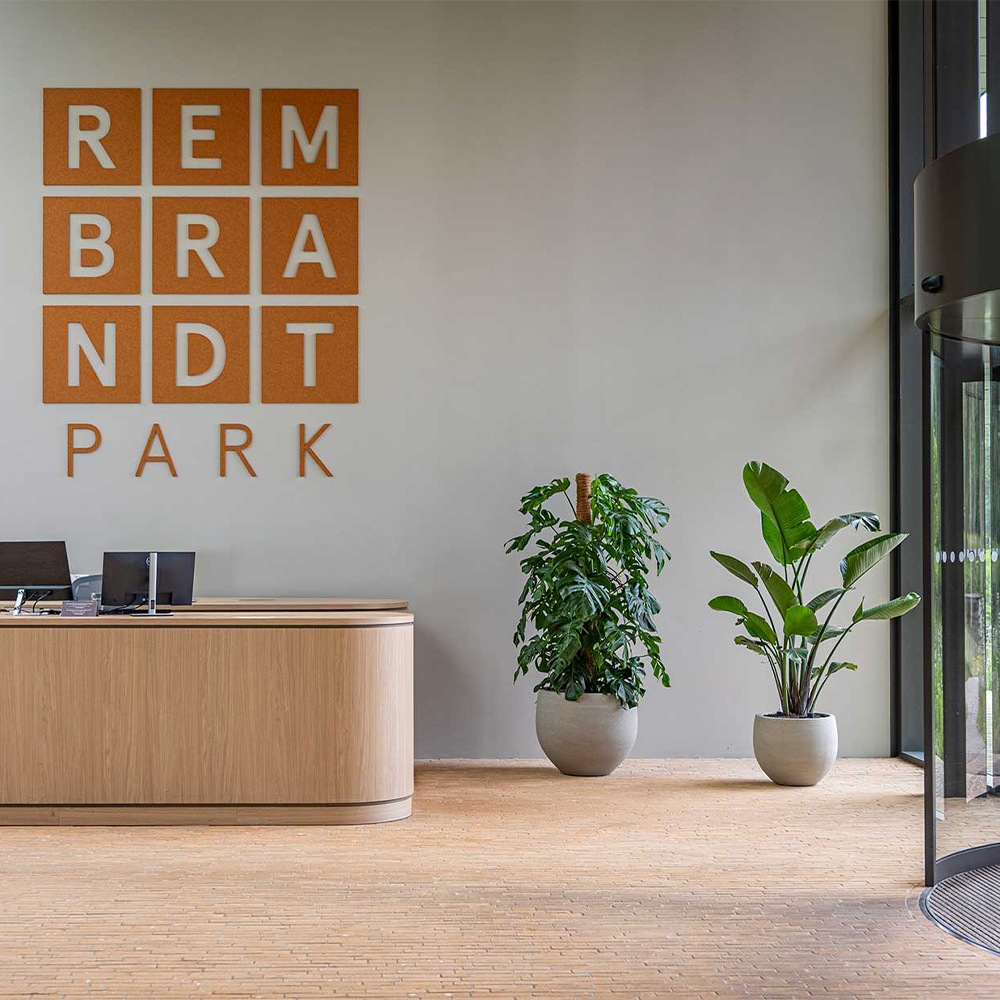
Styling a jumbo planter is therefore not just about size. It’s about light, proportions, growth, maintenance and the courage to make a clear choice.
Curious about our collection of jumbo planters?
Contributed by Inge Lohman of Interieurbeplanting de Klerk
Photos by Raymond Schindeler
Rembrandt Park One in Amsterdam
